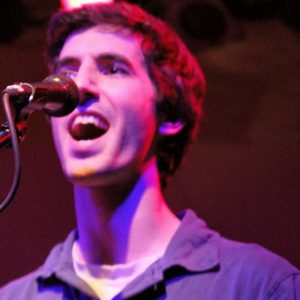
Links: ancient physics prof, another crowdfunding campaign, TMBG on astronomy

Haverford Professor Sings Basics of Physics (Philadelphia Inquirer). The print version of this article said, “In what may not be his most important contribution to the study of physics, the 53- (See Physics on B8)” and then, after the jump, “(Physics Continued from B1) 53-year-old professor has formulated a kind of Schoolhouse Rock for the particle-theory set.” That would make Dr. Smith 5353 years old. No wonder he knows so many physics songs!

Science Notes Web App. An ongoing crowdfunding campaign to create a web app with science music streaming on demand while lyrics display simultaneously.

They Might Be Science: Astronomy Songs (Part II). A nice explanation of how a pair of They Might Be Giants songs (“Why does the sun shine” and “Why does the sun really shine”) illustrates the scientific research process.

Posted in links | Leave a comment

NWBIO 2013, part 2

We science music enthusiasts often talk of using music as a “hook” to pique students’ interest when introducing a new topic. At the 2013 meeting of the Northwest Biology Instructors’ Organization (NWBIO), I accidentally experienced this phenomenon from the student side.

I’m not much of a naturalist, so I signed up for the afternoon shrub-steppe hike mostly to stretch my legs rather than to observe and learn about plants. But after we played a music video about sagebrush (created by students of Jeremy Long) during my morning workshop, I found myself curious about the sagebrush that we encountered on the hike. Where else does this stuff grow? Does it really belong to the same genus as the natural source of the antimalaria drug artemisinin? Fortunately, PNNL ecologist Janelle Downs was there to answer questions (mine and everyone else’s).

Thanks to the appealing lead-in of the song, I was much more interested in sagebrush than I would have been otherwise, and thus learned more than I would have otherwise.

Posted in conferences/festivals | 1 Comment

Spirited discussion at NWBIO 2013

This past weekend I attended the annual meeting of the Northwest Biology Instructors’ Organization (NWBIO), hosted with aplomb by Rik Smith and his colleagues at Columbia Basin College in Pasco. I hadn’t been to this meeting since 2004, so it was great to reconnect with so many enthusiastic and inventive teachers.

Naturally, I talked about science-based music at the conference. In my workshop (“Teaching Biology With Music: Online Tools and Active-Learning Strategies”), I showed data from our ongoing science outreach study, in which outreach event participants take a short quiz before and after watching a science-based music video. Our data so far show statistically significant improvements in the quiz scores after watching the videos.

One point that arose right away was that we do not have a no-music control group, so we can’t tell whether music is superior, equivalent, or inferior to other (non-musical) interventions. Indeed, this is a limitation of the study. Since the outreach events are supposed to be fun for the participants, we’ve chosen NOT to subject half of them to a non-musical, possibly boring alternative to a music video.

Workshop attendees also raised a second, subtler concern. Since the same quizzes are used before and after the video, it was suggested that the improvement we’re seeing is attributable to the pre-video quiz focusing participants’ attention on certain content, rather than to the music video per se.

It’s true that the pre-video quiz affects the way people watch the video. But I see the pre-video quiz as a disclosure of learning goals — i.e., “here are the key items I want you to concentrate on.” The declaration of these learning goals does not guarantee that the students will actually achieve them! Thus I contend that the improvements we’re seeing, while not a big surprise, are not a foregone conclusion either. In the bustling, chaotic environment of a science outreach event, where students’ grades are not at stake, the fact that they improve (on average) is noteworthy, I think.

In any case, it was great to be able to share the data with a skeptical audience and to discuss what the study can and cannot show. The discussion will help me anticipate reviewers’ likely questions when I write up the study for a journal. Thanks, NWBIO!

Posted in conferences/festivals | 1 Comment

Science songster interview #16: Jeremy Long

As someone who sees lots and lots of STEM music videos, I’m rarely surprised by new creations in this realm. But surprise is exactly what I felt upon discovering Prof. Jeremy Long’s 2nd annual Chemical Ecology Filmfest, in which teams of students summarized primary research literature via music videos. (Don’t have access to the full text of Multiple factors promoting narrow host range in the sea hare, Aplysia californica (S.C. Pennings, 1990)? Just consult the song instead!) The 3rd annual Filmfest, released last December, continued in a similar vein.

Read on find out more about Prof. Long and his filmfests!

Jeremy Long
[Prof. Jeremy Long with students and a research subject. Photo from sdsu.edu.]

SAS&M: Tell us a bit about your education and your current position.

JL: Science education: BA in Marine Science from USD, PhD in Aquatic Biology from Georgia Tech, Postdoc at Northeastern University. My interest in chemical ecology started late as an undergrad and was attracted to Georgia Tech because of their emphasis in aquatic chemical ecology. In grad school, I focused on the weird ability of a phytoplankton species to smell its predators and respond by shifting shape in a predator-specific way. I am an Assistant Professor in Biology at SDSU, started 2009. I split my time between campus and our marine lab. Much of my research occurs at the marine lab because of access to flow-through seawater for running experiments with living organisms. For this semester, I am the interim director of the marine lab. I train undergrads, Masters, and PhD students (via our joint-doc program with UC Davis).

Rap education: the first tapes I remember owning were Run DMC “Raising Hell” and Beastie Boys “Licensed to Ill.” I watched A LOT of YO MTV Raps (which I think accounts for much of my rhythm and dancing skills). I’m fairly old school in my music tastes… EPMD, GangStarr, NWA, Biggie Smalls, etc.

Video education: I give props to Randy Olson, a former marine biologist who now is faculty at USC film school. His video Barnacles Tell No Lies is a MUST SEE. I also give props to Dr. Carl Winter (Food Safety scientist) who made music parodies about food safety. And Dr. Tyrone Hayes has been known to summarize his talks at the end with a short rap.

SAS&M: So far, your YouTube channel includes three rounds of the so-called Chemical Ecology Filmfest. What is this — is it associated with a course you teach? — and how did it get started?

JL: You got it. I try to teach chemical ecology once per year in the fall. Some of my friends have indicated that they look forward to the release of these videos each year. I wanted to try this my first semester in 2009 but I made the mistake of requiring a unanimous vote and a few students voted against this. The first round, I let the students focus on a general “role” of chemical signals (e.g. chemical defense). I quickly realized that this wasn’t going to be a long term theme. Thus, the current model is for me to pick a bunch of papers from which the students can select. I think we’ve got the entertainment value down … and I do think there’s value in having the public see scientists in an approachable light. But my hope is that we’re going to move towards enhancing retention of the content of these videos. We’re just now thinking about ways of doing this.

SAS&M: The students do a nice job, but seem to have varied levels of musical training and ability. Do they receive any instruction on how to write songs or make videos?

JL: My goal is to not make the grading based on raw musical talent, especially given that this is a science class. However, I emphasize that quality at all levels (lyrics, song, and video) can be achieved with lots of effort, and that poor effort is obvious. I divide the assignment into the different components (lyrics, song, video), so that I can give feedback that can be addressed. The advantage of assembling the videos from previous courses is that I can now highlight strengths and weaknesses of specific videos. I think this is improvign overall quality of videos. I also have 2-3 training sessions where I go through the basics of the software. Right now, we’re using Garageband and iMovie b/c they’re easy but we’re planning to transition to FinalCutPro.

SAS&M: Have you gotten any reactions or feedback from any of the researchers whose papers were summarized as music videos?

JL: As you might imagine, they are pretty stoked … perhaps just to see that students are actually learning about their science. One of my favorite parts of the course is passing along the positive feedback from the PIs to the students. I also just passed along your sagebrush quiz [based on the filmfest song Sagebrush] to the students and they were stoked. Many of them have indicated an interest in creating links to these videos on their webpages but I haven’t really tracked this.

And while I do my best to correct inaccuracies, I sometimes fail at this. These are a little embarrassing but they’re also an opportunity to learn more via dialogue with the PIs. For an example, see the comments section in the Party Cuz I Found my Prey video.

SAS&M: Have you had any push-back from students and/or faculty who think the Filmfest is misguided? How do you (or how would you) justify the effort that gets put into it?

JL: I was definitely worried about this. However, my impression is that there is general support for this novel teaching method at SDSU. This holds true even for the saltier scientists. Perhaps more telling is that I’m getting very good feedback when I include this in the Broader Impacts section of proposals. In fact, I have an existing grant through Sea Grant that has funding to support the production of these videos. And that’s basically how I justify this … bringing science to a broader science is now expected of our research programs.

SAS&M: Beyond your teaching at San Diego State, you are also doing some K-12 science outreach using rap. Why are you doing that? How is it going?

JL: This is brand new. I’ve strategically partnered with a progressive teacher who has a group of students that participate in a focused, science learning academy. Thus far, it’s going really well. I’ve heard some of their songs and they have potential to make great videos. Major funding agencies (e.g. NSF) encourage outreach at all levels. I hypothesize that these videos may help attract K-12 students to science … because of their basic connection to the music.

SAS&M: What additional science/music question should I have asked you, and what’s your answer?

JL: “Why aren’t you making more of your own videos?”

Believe me, I’m chomping at the bit. I’m flirting with the idea of moving away from the parody … creating completely new lyrics and melodies … and maybe collaborating with others to create new beats too. I think Christopher Emdin is creating a more thorough hip-hop experience when he connects with students (e.g. graffiti, cypher circles, etc.).

Posted in classroom, interviews, songwriting | 1 Comment

Links for April 22, 2013

The Amygdaloids’ second annual Heavy Mental Variety Show (May 18). “The Amygdaloids will play several suites of our original songs on mind/brain topics: the mind-body problem, memory, emotion, unconscious processes, and mental disorders. Each suite will be preceded by a short (3 min) lecture on the scientific or philosophical foundations of the topic by Neuroscientist and Amygdaloid, Joseph LeDoux.”

PODCAST: The Annual Physics Sing-Along. “The Physics Sing-Along [is] an event hosted by Walter Smith, who is a professor of physics at Haverford College. Smith and his wife, Marian McKenzie, started writing physics songs that Smith could use as a teaching tool in his undergraduate classes, but 8 years ago he decided to start the sing-along as a social activity at the meeting. The result is one of the most awesomely nerdy things I’ve ever seen.”

UF professor writes song on benefits of learning chemistry. “University of Florida professor Charles R. ‘Chuck’ Martin loves teaching chemistry and loves performing music. So he decided to combine the two into a song he penned called ‘Bonds of Life.’”

Posted in conferences/festivals, links | Leave a comment

Further misadventures in testing website usability

I’m now more than halfway through the spring outreach events mentioned in a previous post.

There are several reasons why I enjoy these events. First, they enable in-person interactions with live people (as opposed to Internet-based interactions enabled by this website, which are worthwhile too, but not the same). Second, they allow collection of potentially publishable data. (This spring we are measuring whether kids can learn science from music videos, and the results so far have been interesting — more on that later.) Third, they constitute valuable field-testing of SingAboutScience.org’s usability.

A striking example of the latter occurred during the 2011 Paws-On Science weekend, which revealed widespread confusion regarding the database search results page, prompting important improvements.

More recently, this spring’s outreach events showed the new Quizzes section of the site to be less user-friendly than intended.

The specific source of users’ problems was that, when they clicked on a song title on the main Quizzes page, a new browser window opened.

I had various reasons for setting up the Quizzes page that way. One was that having a quiz pop up in a separate “box” gave it a more video game-like look and feel, which I liked. Related to this, the appearance of the new window could be tightly controlled; for example, the “back” button was omitted to prevent users from returning to the pre-video quiz after having watched the video.

Such rationales aside, the fact was that the new window often became hidden behind the other window, and users lost track of it. Some of them clicked over and over on the song title, which reloaded the pre-video quiz in the window that they couldn’t see, thus making the site seem unresponsive and increasing their frustration. Those who didn’t lose the new window spent a fair bit of time resizing it to make it bigger.

Once it became obvious that the opening of new windows was causing lots of confusion, I altered the HTML code so that clicking on a song title would now open a new browser TAB within the same window. A subtle change, perhaps … yet the percentage of people completing the quizzes they started immediately rose from 50% to 75%.

That’s a win for our data collection efforts as well as the site’s usability per se. I just hope that, now that the “back” button is back, people won’t abuse it.

Posted in conferences/festivals, online tools, site updates | Leave a comment

Earthtones: the musical

Since 2008, Professor Wendy Silk of UC-Davis has taught “Earth, Water, Science, & Song,” an interdisciplinary elective course in which students create songs about environmental science. A 2010 article in the California Aggie provides further context, but the course may best be experienced via a webcast of “Earthtones,” the 2013 students’ end-of-quarter show. Tune in for the songs “The Ascent of San Joaquin,” “A Better Way to Study,” “Soilent Green,” “Do You Stink?”, “Life of the Rhizobium,” “Carbon is All Around,” “River Underground,” “Eutrophication,” “Drink It or Die,” “Da Water Flo for Sho,” “Water Around Us,” “The Dance of Water and Soil,” and “You Are the Light of My Life,” plus closing remarks by Diane Ullman, co-director of the UC-Davis Art-Science Fusion program.

Posted in classroom | Leave a comment

Weekend science music events in Seattle and online

UW, Pacific Science Center team up for weekend science fair (KING 5 News). “KING 5′s Christie Johnson spoke with Greg Crowther, a scientist at UW, who leads the project Sing about Science.”

Music and the Mind: #SciSun Hangout on Air. “This #SciSunHOA also will feature singing sensation +Monty Harper, serenading you with songs of science.”

Posted in links | Leave a comment

Post-Easter links: hip-hopping around the web

Brahe’s Battles Kickstarter. Tom McFadden’s crowdfunding campaign to raise money for student-created science music videos. 15 days to go!

The Science of Rhyme: An Evening of Neuro-Lyricism. A cognitive neuroscientist, a rapper, and a turntablist walk into a theatre….

Songs in the Key of Biology: Students Write Hip-Hop to Learn Science (PBS). Another feature on Dr. Chris Emdin of the Columbia University Teachers College and his injections of hip hop into urban science education.

Beth Nielsen Chapman shares the secrets of songwriting success (BBC). The singer-songwriter discusses her recent astronomy-based album The Mighty Sky.

Posted in links | Leave a comment

Science songster interview #15: Dave Nachmanoff

I first met Dave Nachmanoff through Wendy Silk, the leader of the NSF pilot project that helped support development of this website between 2010 and 2012.

While Dave is a musician rather than an academic, his cat-herding skills were obvious from his masterful coordination of a science songwriting workshop at the 2010 UC-Davis’ Oak Discovery Day, which resulted in the song I’ll Take Care Of You If You’ll Take Care Of Me.

In the interview below, Dave explains how he conducts such workshops, what he thinks music can bring to science education, and much more.

Dave Nachmanoff

SAS&M: As a philosophy PhD, you are highly educated, but not as a scientist. What about the realm of science or science education speaks to you or is most interesting to you?

DN: I suppose as a (former) philosopher, the questions in philosophy of science are often interesting to me, also the history of science. I’m not really much of a math whiz, so physics and lots of chemistry etc… tend to confuse me, and I lean more toward biology and life sciences, but the theoretical question of physics are pretty fascinating, as long as someone with better math skills can translate a bit.

SAS&M: You do artist-in-residence sessions or workshops in which you will help a class of students write a song, sometimes about science. Give us an overview of a typical scenario: what the main goal is, how much time you have to reach this goal, and how you get there.

DN: The main goal of the workshop is usually to complete a song by the end of the session, and for the students to learn about the topic that we are writing about by explaining it to me. Also by having to organize the information in a coherent way for a song, they are helped to sythesize information and pick out what is most important among the many things they have learned. The time frame varies, but it is generally a class period of approximately an hour. Sometimes we have two class sessions to complete the song.

The method is fairly simple, but a little hard to summarize. I start by playing a song (usually one of mine or something written by other students), then use that example to explain the parts of songs and how they function. Once that is clear, we brainstorm a song topic (or sometimes the teacher has already done this with them and they have topic ready) and we start to create a song map — planning out what the sections of the song will be about. After that we usually start by constructing lyrics for either the chorus or a verse (often the first verse, but not always) trying to stick with our outline (song map).

Once the class has come up with lyrics for a section, with a little help from me making sure that scansion and meter and rhyme are all OK, I will look for volunteers to sing/hum/whistle an original tune to go with those words. Usually someone can and will do it, and sometimes enough students want to do this, that we can divide it up and have one sing/hum the first line, another the second etc… I will create an accompiment on guitar as we go along which helps to drive the interest/excitement level up, as it starts to sound like a real “song.” Then we work section by section to fill in the parts of the outline. With luck and time we do some re-writing, looking more closely at word choice etc…

In partnership with a good teacher, the science part should be accurate (or at least accurately reflect whatever they are being taught), but being a layman with regard to science I don’t usually interfere too much in that part of things. Sometimes, though not always, the song will educate other students about the scientific topic in a (hopefully) fun and interesting way, sort of like Schoolhouse Rock, but written by the students, not by adults for students. If nothing else, it may help them retain the information that they have learned and then explained to me for the song.

SAS&M: When groups of students write songs with you, what are the main problems that you encounter?

DN: Probably the two biggest problems are the dynamics of working as a group, and musical “shyness.” From picking the song topic to choosing words for lyrics, if the group isn’t functioning well as a team, it’s hard to accomplish a collective task like this. The “shyness” problem is somewhat different depending on the age group and setting — teenagers and pre-teens, especially in mixed gender groups, can be very self-conscious about singing in front of their peers. So sometimes it’s like pulling teeth to get anyone to volunteer to sing/hum a melody, though luckily there are usually a few in any group that will do it.

SAS&M: What fraction of your employment as a musician is devoted to these workshops with students? What other musical activities pay the bills?

DN: This is a pretty small part of what I do (at least recently). I probably do one or two “residencies” a year at the moment, with occasional one-off sessions, like the afternoon session I’m doing at an arts center in Davis in May. My primary work for the last 14 years or so has been touring as Al Stewart’s lead guitarist and opening act. I also do solo concerts — many house concerts, but also folk clubs and small venues and festivals. I write Custom Songs for people and run a small studio where I can produce CDs for others and do session work, often “long-distance” by sending files through the internet. I’m starting to do a bit of teaching (songwriting and guitar) by SKYPE now too.

SAS&M: Some people (like previous SAS&M interviewee Do Peterson) argue that music is best suited for capturing the emotions associated with scientific pursuits, rather than the scientific content itself. Others feel that music is uniquely well-suited for conveying content in a memorable way. What are your thoughts on this?

DN: I’m not sure I can really take sides in the argument, as I don’t see it as an either/or choice. Music is a wonderful tool for communicating about all kinds of topics and one of the great things about songs is that they can appeal to the head/heart/booty, sometimes all at once! Some songs can lead the listener to feel something, some make the listener think, or see things in a new perspective, and some just make you want to dance! As far as science goes — the dancing part might not be so important, but music can certainly convey ideas and content, and also capture emotions related to scientific pursuits.

SAS&M: Actually, previous SAS&M interviewee Lodge McCammon would say that the dancing CAN be a vital component of learning! Moving on, who else’s work in the arena of science-based music do you admire, and why?

DN: I think you have heard some of the songs my friend Jim Ocean has written on science-related topics, Jim is good at catching some of the emotional side of things, but also has a humor about many of his songs that keeps them interesting. I’m a big fan of the band They Might Be Giants and their songs (aimed at kids, but great for any age) about science are pretty amazing in their musical complexity and lyrical cleverness.

SAS&M: Any additional comments?

DN: I can’t claim to have a specialty in science songs, but as someone who is pretty passionate about songwriting, and also about education, I can see music as a wonderful tool that should be integrated into science education in the future. I love songs that are about non-standard topics, and at least so far, the top-40 is not glutted with songs about nuclear fusion or cell-division…. Thanks for doing what you do to shed more light on this hitherto somewhat murky intersection of music and academia!

Posted in classroom, interviews | Leave a comment